GCP ML Node
The GCP (Google Cloud Platform) ML Node allows a workflow to send data to Google ML and store the resulting predictions on the workflow payload.
Prerequisites
If you're new to Google ML, TensorFlow, or machine learning in general, you may want to take some time to look through the following resources:
Configuration
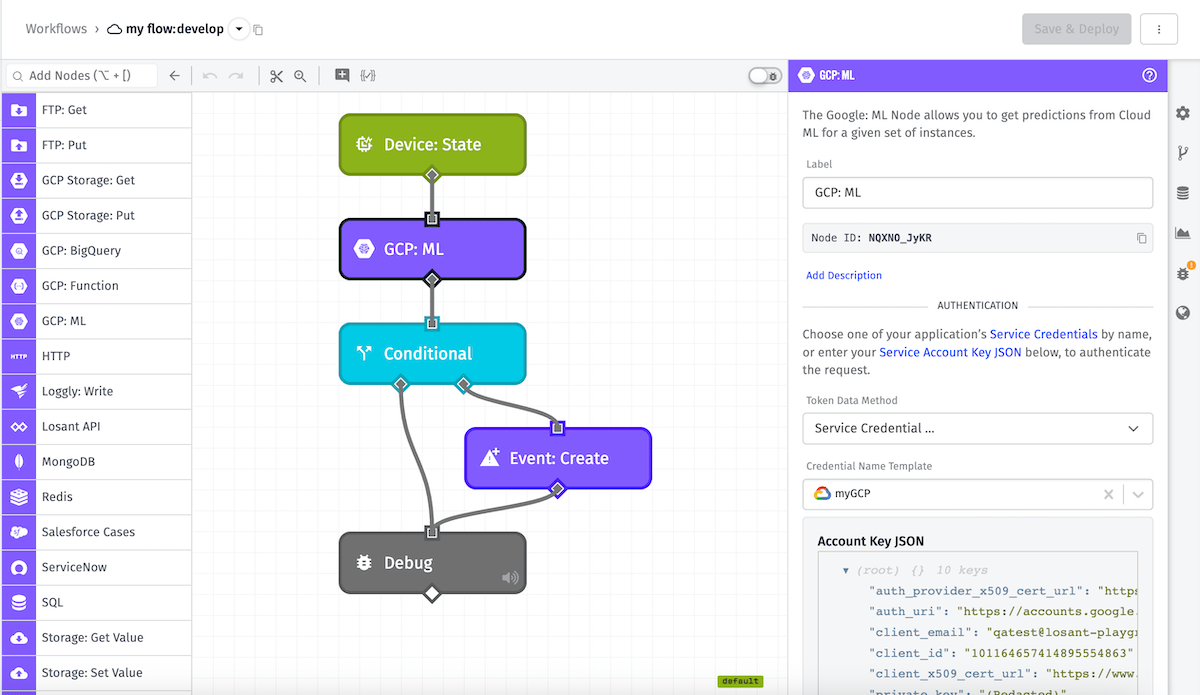
Configuration for the node is broken up into four sections.
Authentication
First, we must enter our Google credentials.
- Token Data Method: A Google service account key is required for the workflow to authenticate with Google ML. For Application and Experience workflows, this may be supplied as a Service Credential, a JSON template, or a payload path. For Edge Workflows, only JSON Template and Payload Path are available.
The next configuration field will depend on the Token Data Method selected.
-
If you selected
Service Credentialas your Token Data Method, Credential Name Template can either be a string template that references your Service Credential name or you can select a Service Credential you have created for your application. -
If you selected
Direct input (JSON Template)(orJSON Templatein Edge workflows) as your Token Data Method, Account Key (JSON Template) can either be a JSON template that references your Google service account key or you may enter it directly. -
If you selected
Direct input (Payload Path)(orPayload Pathin Edge workflows) as your Token Data Method, Account Key Payload Path is a payload path that references your Google service account key.
The third configuration field appears for all Token Data Methods.
- Project ID Template: Can either be a string template that references your project ID, or it can be left blank to use the default project ID associated with your credential. Note: For Edge Workflows, this field is only available in GEA version 1.42.0 or higher.
Cloud ML Model Configuration
Specify the name of the model for which you want to get predictions. You may optionally specify the model version as well; if no version is provided the model's default version will be used. Before you can get predictions from a model, you'll first need to train it with sample data and then deploy it.
Input
The instances path is a payload path that points to the data you want to get predictions for.
Output
The Result Path is a payload path at which to place the prediction results. On a successful prediction, the path is set to the predictions array returned by Cloud ML. If Cloud ML returns an error object in the response body (as a 200 response), the full { error: … } object is placed at the result path instead of the predictions array.
Was this page helpful?
Still looking for help? You can also search the Losant Forums or submit your question there.